Showing posts with label Water leaks. Show all posts

Tuesday, May 7, 2013

Slab Leaks

Early Slab Leak Detection

1. Higher water bill
2. Higher gas bill
3. Moist soil surrounding a building/structure
4. Hot floors
5. Hot or lukewarm water out of cold side of faucets or in the toilet
6. Sound of running water with no fixture(s) actually on
7. Room is humid for no apparent reason
8. Moisture or condensation found under furniture, boxes, throw rugs
9. Mildew smell
10. Water Heater or Boiler constantly running or cycling

What causes slab leaks and how to prevent them!
1. Excessive incoming water pressure: Uniform Plumbing Codes deem water pressure above 80psi to be considered excessive. However, most plumbing part manufacturers recommend 50psi as the optimum pressure rating for long lasting faucets, water heaters, and toilets. Frequently monitor the incoming pressure by testing with a inexpensive ($10.00 local hardware store) pressure gauge http://www.automationdirect.com/adc/Overview/Catalog/Sensors_-z-_Encoders/Pressure_Sensors_-a-_Pressure_Gauges/Dial_Pressure_Gauges_%281.5,_2.0,_2.5_Inch_Dials%29?source=google&keyword=%2Bpressure%20gauges&type=search&gclid=CKXkutTek64CFeUaQgodS3EDLg. Should the pressure be over 75psi consider the installation of a pressure regulator and/or adjusting an existing pressure regulator down.http://www.zurn.com/pages/catalog.asp?ProductGroupID=86&OperationID=11

2. Thermal Expansion:

General Information - What is Thermal Expansion?

When water is heated it expands. For example, water heated from 90°F to a thermostat setting of 140°F in a 40 gallon hot water heater will expand by almost one-half gallon. This is because when water is heated, its density decreases and its volume expands (see below). Since water is not compressible, the extra volume created by expansion must go someplace. During no-flow periods in a system, pressure reducing valves, backflow preventers, and other one-way valves are closed, thus eliminating a path for expanded water to flow back to the system supply. Hence, system pressure increases. http://www.watts.com/pages/learnAbout/thermalExpansion.asp?catId=64 How to curb Thermal Expansion: with the installation of a thermal expansion tank or other authorized device.
3. High PH levels in the water supply:
1.Copper pitting corrosion remains poorly understood despite a number of reports released in recent years. There have been cases of copper pitting problems in waters having high pH, low alkalinity, and significant levels of sulfate and chloride http://www.epa.gov/nrmrl/wswrd/cr/corr_res_copper_ai2.html To correct add a water softener and/or water conditioning device.


Don't let the small leaks become costly repairs.
1. Leaky toilets http://www.epa.gov/WaterSense/pubs/fixleak.html
2. Leaks under sinks
3. Shower Valve leaks
4. Improper caulking around fixtures/faucets http://www.dummies.com/how-to/content/caulking-your-tub-and-shower.html
5. Leaks at toilet base http://www.doityourself.com/stry/h2replacetoilet

All of these minor types of leaks can lead to very unpleasant experiences in the form of mold, mildew, and costly restoration repairs due to water damage. Its wise to perform monthly inspections of all visible plumbing. And, to correct even the smallest of leaks before it becomes a big one (left alone they all do).

Tuesday, December 4, 2012

Water Leaks and the waste of water associated with the leaks!

Water Leaks --- My last post explained the reasons behind leaks. What causes them and how to best protect your plumbing system from having them.

Today, I will speak on just how much water is wasted on various types of leaks.

The number one source of wasted water within the home or place of business is the toilet... Often overlooked and frequently procrastinated on. When a toilet leaks: it tends to be internal (leaking directly from the toilet tank into the bowl and down the drain) and as such, it doesn't cause any visible damage - resulting in the repair being pushed off to some other time... Down the drain goes our precious resource and your money. A leaky toilet wastes between 300 gallons (a slow leak) and 60,000 (constantly running toilet) per MONTH!

The best way to detect a leak besides visually seeing or hearing the leak - is to drop a little food coloring into the toilet tank and wait 10-15 minutes without flushing. If the water in the bowl turns color, your tank is leaking.

Leaking faucets can also increase your water bills!
 Slow Leaks - 450 gallons per month
 Steady Drips - 750 gallons per month
 Slow Stream - 3,000 gallons per month
 Steady Stream - 12,000 gallons per month

The Underground Leak / Under concrete slabs interior aka "slab leak" / Exterior Leaks / Pin Hole leaks
can leak at a rate of (per size of pinhole)
 1/32" leak - 3,600 gals/month
 1/16" leak - 10,800 gals/month
 1/8" leak - 36,000 gals/month
 3/16" leak - 199,000 gals/month
 1/4" leak - 340,000 gals/month

www.aap-allamericanplumbing.com
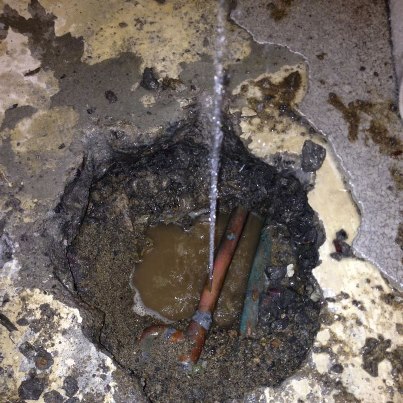
Underground Slab Leak

www.aap-allamericanplumbing.com
Leak on 1/2" copper fitting


www.aap-allamericanplumbing.com
Leak on 1/2" Type M copper pipe


Some Tell-Tale signs a leak exists...
- Water bill increase
- Gas bill increase (indicating a hot side leak)
- Hot spots on ground level floors
- Musty/Mildew smell!
- Water meter dial is rotating with no known use of water
- The constant sound of running water or a hissing noise with no known use of water.
- The sporadic sound of water running or what sounds like the toilet is filling up after its been flushed
- Luke warm or hot water coming out of the cold side tap.

The following metrics were based on the incoming water pressure being between 60-80 psi. The higher the incoming pressure the more waste...

Have a question? Comment below and I will do my best to answer - Thanks for taking a few moments to read my blog, by Anthony Pouliot with http://www.aap-allamericanplumbing.com/leak-detection/